Document no:16A
Official Resolution
Preamble
On 12 March, 2026, the so-called National People’s Congress of China adopted a new legislation titled ” Law of the People’s Republic of China on Promoting Ethnic Unity and Progress,” scheduled to be effective from 1 July, 2026. This law:
- When the People’s Republic of China (PRC) invaded Tibet and coerced the signing of the so-called “17-Point Agreement,” it guaranteed that Tibet’s political system would not be altered and affirmed the rights to regional autonomy and religious freedom. However, the PRC government’s relentless violations of the agreement left Tibetans with no choice but to rise in uprising for freedom. Consequently, His Holiness the Dalai Lama declared the agreement null and void in 1959 in Tezpur, India. The 1982 Constitution of the PRC and the 1984 Law of People’s Republic of China on Regional National Autonomy continue to guarantee regional autonomy and equality, this newly adopted legislation unveils a renewed legal effort to dismantle once again these guaranteed principles.
- This law is crafted in response to a group of Chinese officials and advisors calling for a so-called “Second-Generation Ethnic Policy” about a decade and a half ago. In line with this, the Chinese government has been systematically implementing policies aimed at the eradication of distinct Tibetan identity. Adoption of this law will serve as a blunt legal instrument to further suppress and violently quell any opposition to policies aimed at the annihilation of distinct Tibetan national identity.
- The core of this legislation is the directive to “forge a strong sense of community for the Chinese nation.” This central directive negates the distinct characteristics of each nationality and requires all nationalities to imbibe the notion of “shared joy and sorrow, shared honour and disgrace, shared life and death, and a shared destiny,” thereby subsuming them into a single moulded entity, the so-called “Chinese nation” (Zhonghua Minzu). It further mandates the deployment of the full machinery of the state and the party to enforce this “recognition.”
- The “ethnic unity” defined through this legislation is not founded upon the principle of equality and respect amongst the different nationalities “incorporated” within China, but premises on the criteria that all nationalities must relinquish their distinct characteristics and accept the imaginatively-constructed identity of the “Chinese nation” (Zhonghua Minzu).
- The legislation specifically mandates:
- In the “building of a shared spiritual home of the Chinese nation” and the “establishment of new Chinese cultural symbols,” the legislation provides that the traditional cultures of nationalities are to be reformed, and that architectural design and place-naming practices must reflect symbols of national uniformity (Articles 13 and 14). It further mandates the teaching of the Mandarin from the preschool level onward, as well as the use of nationally standardized textbooks, and designates the Chinese common language as the official language in all government offices. Moreover, where the languages of other nationalities are used, their position and order are required to be subordinate to the Chinese national common language (Articles 15 and 16).The legislation also directs the central government to conduct propaganda, indoctrination, research, and commentary promoting the “history of the development of the Chinese nation” among all nationalities, and to carry out cross-regional exchange programmes for young people (Articles 12, 17, and 27).
- With regard to “interaction, exchange and integration” among nationalities, the legislation promotes the creation of a “social environment conducive to integration” (Article 22) and provides for the “implementation of specific measures in areas such as housing construction and population management “(Article 23). In addition, it mandates the “strengthening of service platforms for population migration” (Article 24) and supports “cross-regional employment and entrepreneurship” (Article 25). It further calls for “cross-regional recruitment of students between ethnic regions and other regions” (Article 26), as well as “guide the flow of cadres to the grassroots in ethnic regions” (Article 49) to advance these objectives.
- The legislation calls for all work in “ethnic” regions to be carried out under the implementation framework of the “Party committee’s unified leadership, lawful administration by the government, coordination by the United Front Work Department, performance of duties by the Ethnic Affairs Department, close cooperation among all departments, and the participation of society as a whole” (Article 41). Furthermore, “ethnic” affairs are to be incorporated into the “social governance mechanism” and monitored through “scientific and technological support” (Article 51). Under the pretext of “unified governance by law,” this framework undermines the legislative authority of autonomous regions, not only removing their power to make adaptive amendments to central legislation, but also rendering previously enacted autonomous and specific regulations effectively unenforceable. It further mandates the “completion of alert and reporting systems for major matters in the ethnicity sector, strengthen the investigation, identification, assessment, early warning, and handling of major risks and hazards in the ethnicity sector” (Article 52).
- In order for the legislation to serve its stated purpose, the implementation of all economic and social development projects is made conditional upon the prerequisites of “forging a strong sense of community for the Chinese nation” and “preserving national unity and opposing separatism” (Article 33). It further provides that “no organization or individual may interfere with the freedom of marriage on grounds such as ethnic identity, customs, or religious beliefs” (Article 40), and prohibits, under such pretexts, acts that “intentionally cause or escalate conflicts or disrupt public order” (Article 53). The legislation also calls for the pursuit of accountability in cases where any official, organization, or individual fails to strictly implement its provisions, including the imposition of criminal penalties (Articles 57 and 58). Not only must the entire process of training, selection, employment, and management of cadres undergo political vetting (Article 49), but the legislation also extends its jurisdiction beyond the territorial borders of the PRC by stipulating that “any organization or individual outside the territory of the People’s Republic of China that engages in acts undermining national unity and progress or creating ethnic division against the People’s Republic of China shall be pursued for legal responsibility in accordance with the law” (Article 63).
- This legislation, designed to rescind or dilute the rights of nationalities guaranteed under the PRC’s Constitution and the Law on Regional National Autonomy, represents an attempt to cloak in a veneer of “legality” the PRC government’s ongoing and aggressive pursuit of policies aimed at the annihilation of the Tibetan nationality within Tibet. It clearly outlines the procedures, steps, and objectives for “forging a strong sense of community for the Chinese nation,” extending from central government institutions down to grassroots administrations, and from individual households to the consciousness of every individual. It is therefore considered imperative that a formal resolution be adopted to counter the grave threats posed by this legislation.
Resolution
- This resolution hereby recognizes that the new law, “Law of the People’s Republic of China on Promoting Ethnic Unity and Progress,“ is in direct violation of international laws and norms as well as the guarantees enshrined in the PRC’s own Constitution. Therefore, this law possesses neither legal legitimacy nor moral authority over the Tibetan people.
- Tibet, the Land of Snow, is undeniably a nation occupied by the People’s Republic of China. By every measure of historical trajectory, religious and cultural identity, and international law, the Tibetan people, descended from the six ancestral clan, can never be assimilated into a component of the so-called “Chinese Nation” (Zhonghua Minzu). In recognition of the inherent rights of Tibet and the Tibetan people, the common aspirations of Tibetans both inside and outside Tibet, and the immediate and long-term interests of the PRC itself, the Chinese government is called upon to withdraw this legislation of forced assimilation, which stands in violation of its own Constitution; to bring to an immediate halt of all policies aimed at the complete eradication of distinct Tibetan national identity; and to move resolutely toward resolving the Sino-Tibet conflict through dialogue.
- The relevant agencies of the United Nations (UN) must earnestly undertake a comprehensive legal review of the PRC’s legislation on forced assimilation. The UN must employ all available mechanisms to prevent the crime of genocide. It is further urged with utmost urgency that the international community rigorously investigate the legal accountability of all those perpetrating the crime of genocide and impose stringent penalties to ensure that no perpetrator goes unpunished.
- The preservation of one’s religion, culture, language, traditional customs, and national dignity is an inherent right of every nationality. Therefore, our brethren inside Tibet must continue with unyielding spirit and unwavering resolve as Tibetans, and remain steadfast in the conviction that the rays of freedom will soon shine upon Tibet.
- All Tibetan organizations and individuals in exile are urgently called upon to begin within their immediate networks and extending their outreach as widely as possible, to expose the Chinese government’s malicious, legally backed policies of the Sinicization of Tibetan distinct identity, and to mobilize all available capacities and resources in sustained advocacy efforts aimed at bringing an immediate withdrawal of such policies.
- All Tibetan organisations and individuals residing in free countries shall, during the fourth week of September of each year, organise activities aimed at preservation and celebration of distinct Tibetan national identity.
- The Central Tibetan Administration (CTA) shall strive to effectively challenge and counter the PRC’s legislation and policies aimed at the erasure of the Tibetan national identity through robust international engagement.
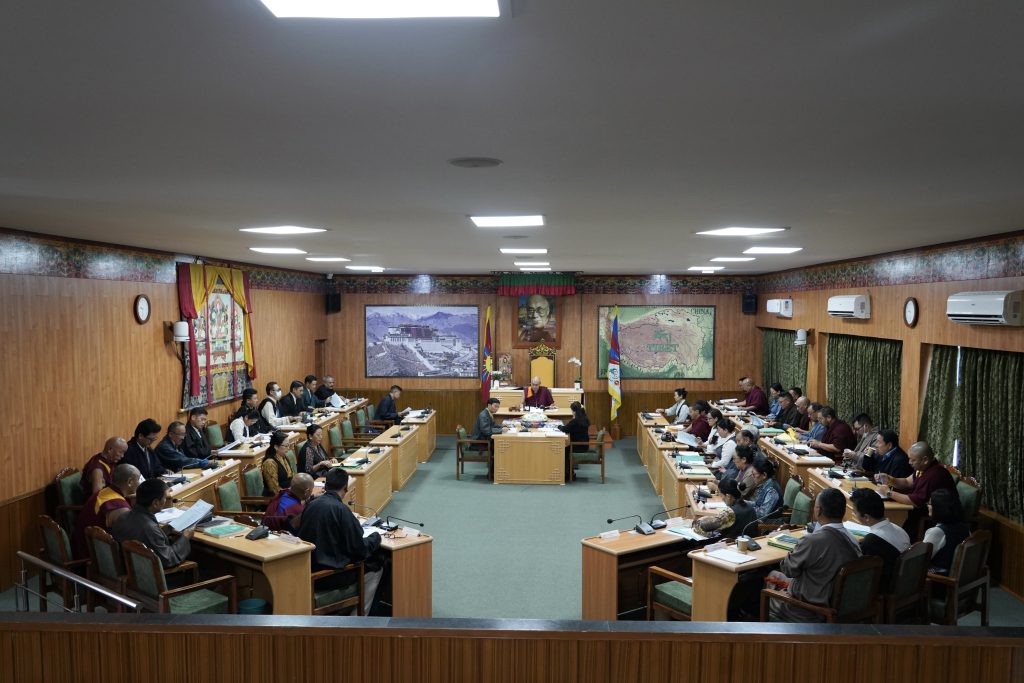
The above resolution was unanimously adopted after extensive discussion by the 17th Tibetan Parliament-in-Exile at its 11th session on the 23rd of March in 2026.
. . . . . . . . . . . . . . . . . . . . . . . . . . . . . . . . . . . . . . . . . . . . . . . . . . . . . . . . . . . . . . . . . . . . . . . . . . . . . . . . . . . . . . . . . . . . . . . . . . . . . . . . . . . . . . . . . . . . . . . . . . . . . . . . . . . . . . . . . . . . . . . . . . . . . . . . . . . . . . . . . . . . . . . . . . . . . . . . . . . . . . . . . . . . .
* In case of any discrepancy between this English translation and its Tibetan original, the latter should be considered as authoritative and final for all purposes.