Document No. 13
Official Resolution of Gratitude for the Kindness of His Holiness the Great, Omniscient Fourteenth Dalai Lama, the Supreme leader of the Tibetan People
PREFACE
His Holiness the Great Fourteenth Dalai Lama, the human manifestation of Avalokiteshvara, the lord of the three realms of existence and the patron-deity of Tibet, is a champion of world peace, master of all Buddhist canons, the protector of all Tibetans, their supreme leader, their edifying guide, the symbol of their identity and solidarity, a supreme twenty-first century teacher, and a free spokesperson of the Tibetan people, with his name, to cite it in fullness, being Jetsun Jampel Ngawang Lobsang Yeshe Tenzin Gyatso Sisum Wanggyur Tsungpa Meypey De Pel-Sangpo. In connection with his milestone 90th birthday being celebrated this year, it bears remembering that since the age of 16, until now, when he has attained 90 years of age, His Holiness has, undaunted by all hardships that came his way, continued to bear responsibility as the spiritual leader and temporal head of Tibet for the sake of the Buddhist faith and the sentient beings in general and, especially, during the period of severe threat to the very existence of the Snowland of Tibet. This was a period when the religion and governance of the country had reached a critical stage of such intensity that it was being destroyed in a manner akin to the relentless depletion of a burning butter lamp. Our feeling of gratitude to him for his still continuing efforts in these spheres of activities, therefore, remains immeasurable.
It was on the 5th day of the 5th month of the Tibetan Wood-Hog year, 1935, that His Holiness the Dalai Lama was born to his father Choekyong Tsering and mother Sonam Tso at Tagtser Village in the Tsongkha region of Domey province of Tibet, with the given name of Lhamo Dhondub. His birth was initially predicted in a vision which appeared in the sacred Lhamoe Latso lake. By his remembrances of his past life and his behaviours and so forth, the committee dispatched by the government of Tibet recognized this child incarnate lama as the 14th Dalai Lama after subjecting him to tests of such vigour as one would to determine the nature and purity of an item of gold, and this was duly endorsed and confirmed by the National Assembly of Tibet. And the committee successfully escorted him to the capital of Tibet, Lhasa.
In the year 1940, His Holiness was ushered to the Golden Throne in a ceremony held in the Sizhi Phuntsok Ḥall in the Potala Palace. And while he was deeply immersed in the study and contemplation of the Buddhist treatises after that, the communist government of China began its armed incursion into the country from its eastern border in the year 1949. As a result, the religious and political situation in Tibet became critical and verged on their decimation. Such was the moment when all subjects of Tibet, both the monastic and lay communities, made ardent prayers to His Holiness, beseeching that he took the rein as the temporal head and spiritual leader of the country. And so, out of lack of any choice, His Holiness assumed those roles at a ceremony held on the 17th of November in 1950 even though he was, by Tibetan calendar, just 16 years of age. And being aware of the actual wellbeing of the general masses of the Tibetan people at that time, he felt that the prevailing government system of Tibet was in need of reform. He therefore established a reform office for this purpose in the year 1954. Further on, in the year 1956, he newly established a public vigilance department as a check on official wrongdoing. And for many years, in keeping with the demands of the time and circumstances, His Holiness employed tact in an attempt to coexist with the government of China, but all to no avail. Worse, the government of China simply trampled on the so-called 17-Point Agreement which it had forced the Tibetan side to sign under duress. As a result, Tibetans from across the land launched large-scale campaigns of opposition to the government of China. These and other developments led to the situation in Tibet becoming enormously precarious.
In the year 1959, His Holiness appeared for his Geshe Lharampa degree (equivalent to Ph. D). In the meantime, the government of China extended an invitation to him, asking him to attend a theatrical show at a People’s Liberation Army camp in Lhasa. And he was confirmed to attend the programme on the 10th of March. However, the Chinese side had called for certain conditions to be met for His Holiness to attend the event. These included the requirement that he be accompanied only by one or two personal security guards, but without being armed with any sort of weapon. From this and other prior conditional demands as well, the Tibetan people felt that a plot was being hatched which threatened nothing less than the very personal safety of His holiness the Dalai Lama. People from all the three provinces of Tibet residing in Capital Lhasa were spontaneous in their reaction, which did not require any prior discussion or resolution. They clamoured that His Holiness not visit the Chinese army camp to attend the theatrical show there, And they surrounded His Norbulingkha palace, providing him security and protesting against the actions of the Chinese government. This day on which the Tibetan people staged a spontaneous uprising remains of great importance and has continuously been marked since then as the 10th of March Tibetan Uprising Commemoration Day. Because at that time the Chinese army started targeting the Norbulingkha Palace in Lhasa with artillery shells, His Holiness the Dalai Lama was left with no option but to leave his country with his retinue in the middle of the night on the 17th of March in 1959, escaping to India to seek asylum there.
Immediately after arriving in India in exile in April 1959, His Holiness the Dalai Lama met with the country’s Prime Minister Jawaharlal Nehru and on successive occasions appealed for efforts to help and extend support to the newly arrived refugees from Tibet. He established a government in exile that was a continuation of the government of Tibet headed by him, complete with its Kashag (cabinet) and the different administrative offices functioning under it. Likewise, in the course of time, His Holiness also established monastic centres, settlements, educational institutions, cultural centres and so forth. By these means, His Holiness has helped to revive and flourish, as the case may be, the religious and cultural heritage of Tibet, achieving admirable results in their robust sustenance in exile today.
In order that the Tibetan governmental set up in exile may be able to transform into a fully functioning democratic system, His Holiness initially set up for the first time in the year 1960 a Tibetan parliament constituted by deputies elected by the Tibetan public. This was followed, in 1961, by the announcement of a document outlining the salient features of a future free Tibet, and, in 1963, by the promulgation of a democratic constitution of Tibet. Then, in the year 1991, His Holiness made the Tibetan Parliament-in-Exile an effective law-making body with full legislative function. Later, on the 28th of June in 1991, His Holiness gave his assent to the Charter of Tibetans in Exile which had been adopted by the 11th Tibetan Parliament-in-Exile. He thereby ensured that since that day, the Tibetan government in exile became a modern democratic entity fully functioning on the basis of a basic law. Besides, in the year 2001, a major step in democratisation was taken by His Holiness that the Kalon Tripa, the head of the Cabinet of the Central Tibetan Administration was directly elected by the Tibetan people. Later, in the year 2011, His Holiness the Dalai Lama bestowed his entire political and administrative powers and responsibilities to the elected leaders of the Tibetan people, thereby empowering them as the true representatives of the Tibetan people in Tibet and in exile with mandate to fulfil their national aspirations.
Although immediately after arriving in exile in India, His Holiness the Dalai Lama directed his efforts at regaining the independence of Tibet in keeping with its historical status as such, he later abandoned that goal, keeping in view the reality of the overall global situation and, likewise, following the response by China’s paramount leader Deng Xiaoping that everything except independence could be discussed and resolved. His Holiness then adopted a position that was mutually beneficial to both the sides, and delegations of Tibetan representatives were able to visit Tibet, while Tibetans in Tibet and those in exile were also able to visit each other. Likewise, since the year 2002, some nine Sino-Tibetan dialogues were made. Nevertheless, those holding power in China today lack political will and courage due to their suspicions and doubts which made them feel insecure. As a result, a positive forward movement towards the resolution of the Sino-Tibetan conflict could not be achieved thus far. For this lack of progress, the responsibility lies entirely with the government of China.
The United Nations General Assembly adopted three resolutions on Tibet in the years 1959, 1961 and 1965. Likewise, the European Parliament as well as the parliaments and governments of many major countries have adopted a number of resolutions on the issue of Tibet. In fact, the Senate and House of Representatives of the United States of America Congress has passed resolutions and legislations expressing support for the issue of Tibet with the country’s president having put his signatures on those measures.
To sum up, during the more than 60 years that we have spent living in exile, the Tibetan people have emerged as the most successful refugee community in the world under the exceptional leadership of His Holiness the Dalai Lama. In this respect, it bears noting that His Holiness has based the Tibetan struggle entirely on non-violent means, directed all his activities towards contributing to global peace, promoted love and compassion throughout the world, acted on four principal commitments rooted in kindness, and successfully consolidated as one all the Tibetan people of the tsampa-eating culture belonging to all the three provinces of Tibet and religious schools of Tibet in successfully spreading across the world awareness about the issue of Tibet and so forth. There is absolutely no question that it is owing solely to the deeds and kindness of His Holiness the Dalai Lama that we are in a position to boast of these successful outcomes. The Tibetan Parliament-in-Exile therefore sees it as important to adopt a special resolution to express gratitude to him in this milestone year of celebrating his 90th birthday.
RESOLUITION
- The Tibetan Parliament-in-Exile feels immense gratitude to His Holiness the Dalai Lama for the positive assurances he has given numerous times that he has experienced signs, manifestations, prophesies and so forth which have indicated that he would live to be one hundred plus decades of years of age. In this regard, we pray with great earnestness that His Holiness may live for a hundred aeons to be able to continue to act as a spokesperson for Tibet and the Tibetan people, devote himself in efforts towards reaching a fair solution to the just cause of Tibet, and promote peace and compassion throughout the world. During the three-day, 15th Tibetan Religious Conference, which started on the 2nd of July 2025, His Holiness gave his assurance that the institution of Dalai Lama would continue with the coming of his reincarnation, for which we express profound gratitude. We remain committed to abiding solely by His Holiness the Dalai Lama’s announcement made in 2011 on the issue of his reincarnation and his intend on this issue reiterated this year, and will never accept any interference which China may make for political purposes.
- His Holiness the Dalai Lama assumed full responsibility as the temporal head and spiritual leader of Tibet when he was 16 years old. After arriving in exile, he bestowed the gift of democracy to the Tibetan people. He worked tirelessly, in the face of multitudes of daunting obstacles, for the success of the Central Tibetan Administration, achieving great international success in efforts towards achieving a fair solution to the just cause of Tibet and in other fields. While he continued as the temporal head and spiritual leader of Tibet, His Holiness accomplished the consolidation of the unity of the people of all the three province of Tibet and also the revival of all the various Buddhist traditions and the Yungdrung Bon religion of Tibet in an entirely non-sectarian approach in exile. All this is owing to the selfless dedication and kindness of His Holiness the Dalai Lama to whom we owe infinite debts of gratitude. The Tibetan people will remain indebted and remember His Holiness for all these acts of kindness.
- The government of China has employed various soft and brutal approaches to carry out its vicious plans to obliterate the religion, culture, language, ethnicity, and natural environment of Tibet and its people. Nevertheless, sincere gratitude to the tireless efforts of His Holiness the Dalai Lama, the religion, culture, language, and so forth of Tibet have been successfully revived in exile; & more so, it has received international interest and esteem. This is owing entirely to the kindness of His Holiness the Dalai Lama, for which the Tibetan Parliament-in-Exile wishes to express immeasurable gratitude. And we, the Tibetan people, vow to make efforts to carry forward the wishes of His Holiness the Dalai Lama to continue to preserve and develop them.
- His Holiness the Great 14th Dalai Lama has immersed himself with industrious zeal in the trio of studying, reflecting and meditating on the Buddhist texts, leading to the arising in his mind of the profound essence of the Buddha Shakyamuni’s sacred teachings. It is for this reason that His Holiness has been able to engage in discussions not only with the Buddhist faith, but also renowned experts in the field of modern sciences with his knowledge of Buddhist psychology. Besides, His Holiness has newly introduced the study of modern science in the major Tibetan Buddhist education centres. Such numerous other actions have made him an object of universal esteem without any question about religion. Likewise, with the introduction of secular ethics as a common subject of study in the modern education curricula, His Holiness has succeeded in promoting the inculcation of ethics in people from the time they are children of impressionable age, with the result that the Tibetan Buddhist teachings have earned a special kind of admiration, respect and interest across the world. All this is owing entirely to the deeds of His Holiness the Dalai Lama for which we express immeasurable gratitude to him.
- During the entire period he has spent in exile, His Holiness has ensured that the struggle for the realization of the just cause of Tibet is based entirely on the non-violent approach, has taught the value of love and compassion in whichever place he visited in this world, and taken peace initiatives and so forth, all of which have earned universal renown as the very embodiment of love and compassion, and a champion of world peace. Besides, he has earned hundreds of awards and honours, including the most prestigious peace award in this world, the Nobel Peace Prize, which was presented to him in 1989. The fact that His Holiness the Dalai Lama continues to be active in pursuing the four major commitments of his life has earned him admiration, support, and cooperation in implementation from people across the world. These have become part of his supremely outstanding visions for which the Tibetan Parliament-in-Exile wishes to express immense gratitude. Including us, the Tibetan people, every individual devoted to His Holiness the Dalai Lama should dedicate themselves to making efforts to put these great ideas into practice.
By the Tibetan Parliament-in-Exile
11 September 2025
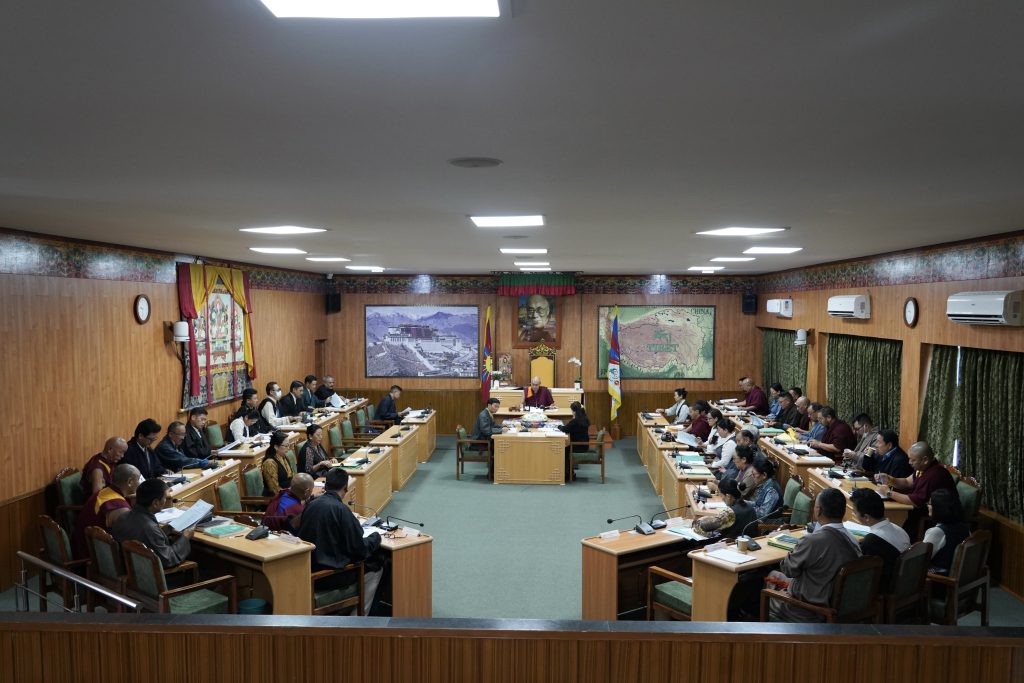
The above resolution was unanimously adopted after extensive discussion by the 17th Tibetan Parliament-in-Exile at its 10th session on the 11th of September in 2025
. . . . . . . . . . . . . . . . . . . . . . . . . . . . . . . . . . . . . . . . . . . . . . . . . . . . . . . . . . . . . . . . . . . . . . . . . . . . . . . . . . . . . . . . . . . . . . . . . . . . . . . . . . . . . . . . . . . . . . . . . . . . . . . . . . . . . . . . . . . . . . . . . . . . . . . . . . . . . . . . . . . . . . . . . . . . . . . . . . . . . . . . . . . . .
* In case of any discrepancy between this English translation and its Tibetan original, the latter should be considered as authoritative and final for all purposes.