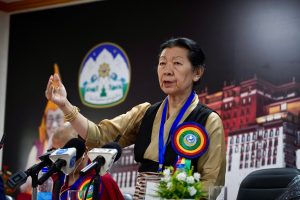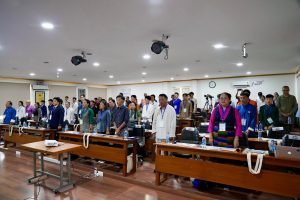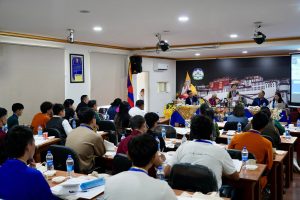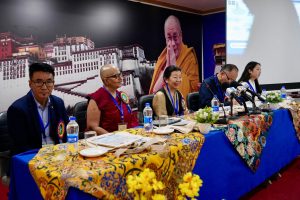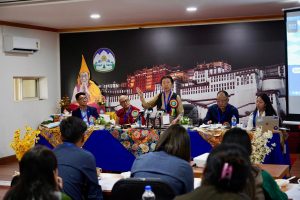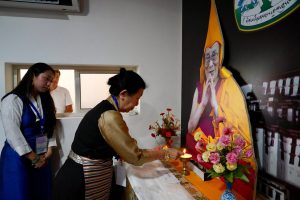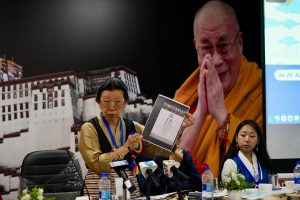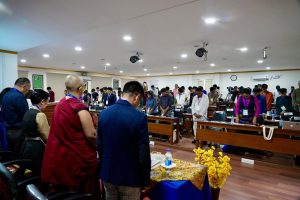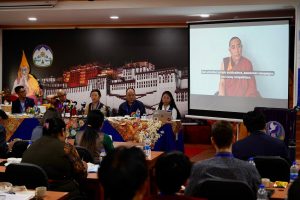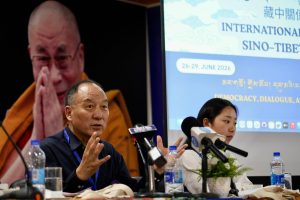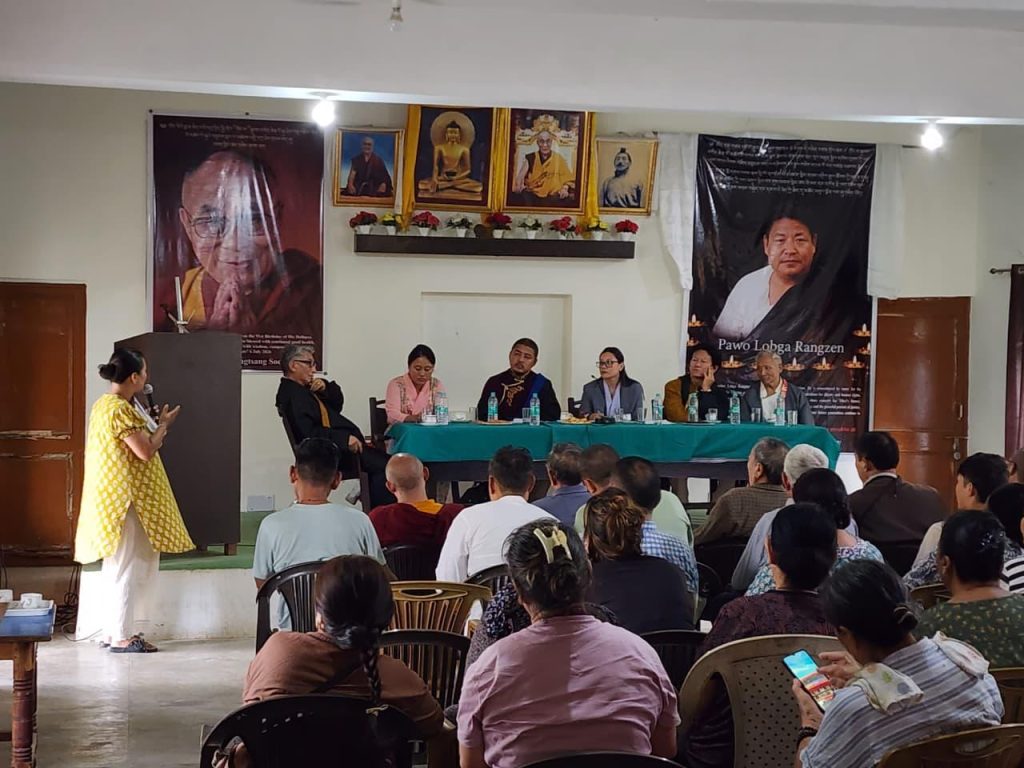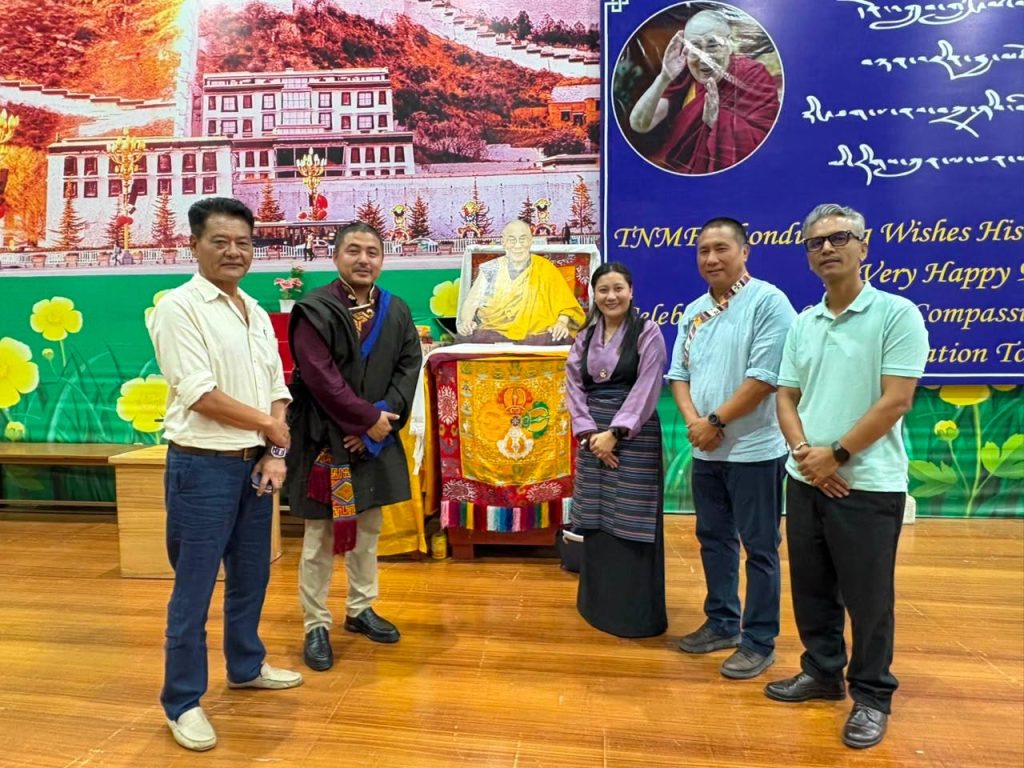
Dharamshala: Speaker Dolma Tsering Teykhang of the Tibetan Parliament-in-Exile as the Chief Guest spoke at the International Conference on Sino-Tibetan Relations: Democracy, Dialogue and the Middle Way Approach, organized by the Global Tibetan People’s Movement for the Middle Way Approach. The conference commenced on 26 June 2026 at the Administrative Training Welfare Society in Dharamshala and will continue through 29 June 2026.
The other panelists included special guest Parliamentarian Dawa Tsering Bari, former Representative at the Office of Tibet, Taiwan; Tashi Tsering, Human Rights Network for Tibet and Taiwan; and Prof. Kaveri Gill, Resident Senior Fellow at Shiv Nadar University. The conference, attended by students, scholars, researchers, and members of the public, aims to foster discussion on the future of Sino-Tibetan relations and the relevance of the Middle Way Approach.
Addressing the gathering, the Speaker underscored the significance of Sino-Tibetan dialogue, tracing its origins to China’s growing expansionism and the People’s Republic of China’s occupation of Tibet in 1949. The Speaker also highlighted key historical facts concerning Tibet and China, providing context for the longstanding issue. Furthermore, the address explained how the Middle Way Approach was first proposed by His Holiness the Dalai Lama and was subsequently adopted as the official policy of the Central Tibetan Administration through the Tibetan Parliament-in-Exile.
“Despite genuine effort and sincere intention on the Tibetan side, the Chinese counterpart continues to lack the determination and commitment necessary to resolve the Sino-Tibetan conflict, with the formal dialogue remaining stalled since January 2010.” The Speaker reiterated that the One-China policy has no connection to Tibet in any form, as it concerns Taiwan, China, and the United States. She emphasized that the people of Taiwan have the right to express their concerns and uphold their own position on the matter. She further stated that the Sino-Tibetan conflict cannot be resolved unless the People’s Republic of China resumes dialogue with the representative of His Holiness the Dalai Lama or the Central Tibetan Administration.
The Speaker explained that international politics are often shaped by economic leverage, trade agreements, geopolitical power, and other strategic interests, leading many countries to yield to economic pressure. She also described how the Middle Way Approach seeks a compromise between maintaining the status quo under Beijing’s current rule and pursuing full independence for Tibet. As an example, she noted that after a meeting between the Danish Prime Minister and His Holiness the Dalai Lama in 2009, China strongly criticized Denmark. In response, the Danish government issued a formal diplomatic statement reaffirming its One-China policy, stating that Tibet is an integral part of China and that Denmark does not support Tibetan independence.
Highlighting the historical basis of Tibet’s independence under international law, the Speaker explained that Tibet officially reasserted its independence in 1913 following the collapse of China’s Qing Dynasty. She further noted that, in 2022, the U.S. Congressional-Executive Commission on China (CECC) held a congressional hearing at the U.S. Capitol titled “Tibet: Barriers to Settling an Unresolved Conflict.” During the hearing, Prof. Michael van Walt van Praag, Professor of International Law and Executive President of Kreddha, and Prof. Hon-Shiang Lau, Retired Chair Professor at the City University of Hong Kong, testified and presented historical research supporting the view that Tibet was never historically a part of China. The Speaker encouraged participants to familiarize themselves with these historical perspectives and to take every available opportunity to raise awareness about Tibet. She recommended not only reading Prof. van Walt van Praag’s Tibet Brief 20/20 and Prof. Lau’s Tibet Was Never a Part of China Since Antiquity, but also encouraged others to make these two books available in the libraries of their localities.
The Speaker also highlighted that the People’s Republic of China’s false claim that “Tibet has been part of China since antiquity,” coupled with the willingness of some countries to yield to the PRC’s pressure, has hindered the Sino-Tibetan dialogue. The Speaker explained that following the appointment of Under Secretary Uzra Zeya as the Special Coordinator for Tibetan Issues, U.S. lawmakers wrote to her outlining a framework to advance U.S. policy on Tibet. The letter specifically welcomed the language used in the 2020 Country Reports on Human Rights Practices, noting with appreciation that the Tibet section did not refer to Tibetan areas as “part of the People’s Republic of China.”
The Speaker further noted that, as stated in the lawmakers’ letter, the Chinese government has made it a precondition for dialogue that His Holiness the Dalai Lama acknowledge Tibet as having been part of China “since ancient times.” His Holiness has consistently refused to do so, maintaining that the claim is historically false. The Speaker also emphasized that the Chinese government has pressured several governments to publicly state that “Tibet is part of China”. According to the lawmakers’ letter, such actions by the Chinese government constitute significant obstacles to the resumption of meaningful Sino-Tibetan dialogue.
Concluding her remarks, the Speaker called upon Tibetans living in the free world to make meaningful contributions to the Tibetan cause at every available opportunity. She urged them to remain steadfast in their commitment, actively engage in advocacy and awareness-building efforts, and pledge to do everything within their capacity to support the just cause of Tibet and the aspirations of the Tibetan people.